

When You Feel You Aren’t “Spiritual” Enough
Let’s be honest for a second. How often do you feel like you’re doing this whole “life” thing wrong? We live in a world that demands perfection. You scroll through social media and see people with immaculate morning routines, drinking green juice in spotless, sun-drenched living rooms. They seem so calm. So put together.
Then you look at your own life. Maybe your sink is full of dishes. Maybe your mind is racing with anxiety about an email you forgot to send. You try to meditate, but your brain just screams about your grocery list. You might think, “I’m just not cut out for this spiritual stuff. I’m too messy. I’m too loud. I’m too broken.”
We often believe that to connect with something greater—whether you call it the Universe, God, or Inner Peace—we need to be perfect. We think we need to know the right chants, sit in the perfect lotus position, and have a mind as clear as a mountain lake.
But what if that’s not true? What if the most profound connection comes not from following the rules, but from simply showing up exactly as you are?
There are many ancient Shiva devotion stories that challenge the idea of perfection, but one stands out above the rest. It isn’t about a sage who meditated for a thousand years. It’s about a wild, uneducated hunter who didn’t know a single prayer, yet managed to capture the heart of the Divine.
This is the story of Kannappa. And if you’ve ever felt like an outsider, this story is for you.
The Wild Hunter and the Silent Stone
Long ago, deep in the dense, untamed forests of Southern India, there lived a man named Thinna.
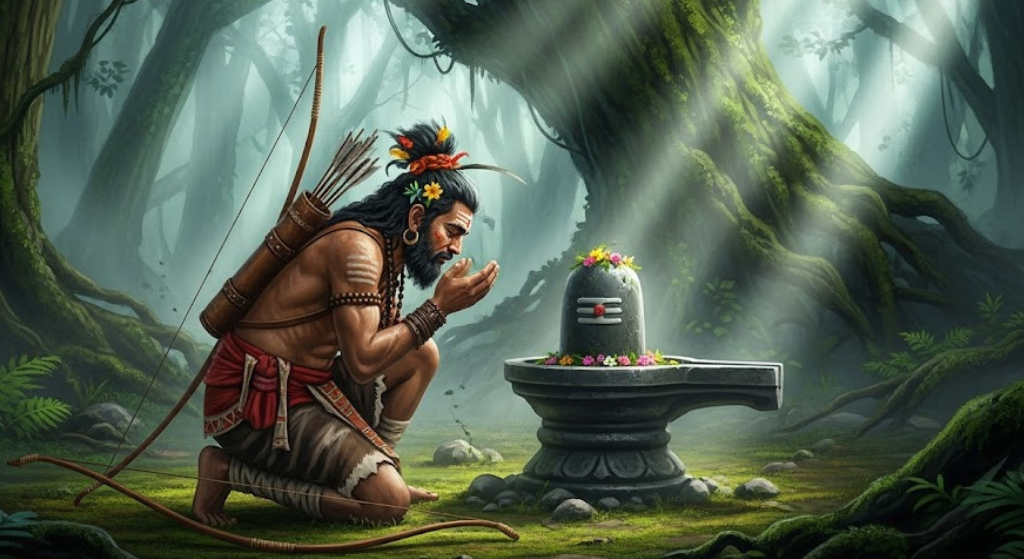
Thinna was not a monk. He wasn’t a scholar. He was a hunter. He was a man of the earth, muscular and rough, with calloused hands and wild hair. He knew the language of the birds and the tracks of the deer, but he knew nothing of scriptures or temples. His life was about survival—hunt, eat, sleep, repeat.

One day, while chasing a boar deep into the Kalahasti forest, Thinna stumbled upon a clearing he had never seen before. In the center of that clearing stood a small stone shrine. Inside was a Shiva Lingam—a cylindrical stone symbol representing Lord Shiva, the consciousness that pervades the universe.
Thinna had never been taught how to worship. He didn’t know the rituals. But the moment his eyes landed on that stone, something shifted in his chest. It was a physical sensation, like a heavy door swinging open in a dark room. He felt an overwhelming wave of love, as if he had just found a long-lost parent.
He ran to the stone and hugged it.
“Oh, Lord of the Forest!” he cried out. “You are all alone here! Who feeds you? Who protects you from the tigers at night?”
Thinna didn’t see a stone idol; he saw a living presence that looked lonely. His hunter instincts kicked in. He needed to take care of this presence.
The Unconventional Offering
He ran back to his camp to get food. He cooked the best meat he had—wild boar—tasting pieces of it first to make sure it was tender and delicious. In the orthodox world, this is a huge taboo. You never offer food that has been tasted (tainted by saliva) to a deity. But Thinna didn’t know the rules. He only knew love.
He realized he had nothing to carry water in for Shiva’s bath. So, he filled his mouth with water from the river. He realized he had no flowers, so he plucked wild blossoms and tucked them into his matted hair to carry them.
He returned to the shrine with his hands full of meat and a bow and arrow.
He approached the stone. He spat the river water from his mouth onto the Lingam to “bathe” it. He shook his head so the flowers fell from his hair onto the stone. Then, he offered the chewed meat with great affection, saying, “Here, eat! It is sweet and soft. I chose the best parts for you.”
He sat guard all night, arrow notched, protecting his Lord from wild beasts, until exhaustion took him just before dawn. He then left to hunt again.
The Priest’s Horror
Later that morning, the designated temple priest, a devout Brahmin named Sivagochariar, arrived to perform the daily rituals. He was a man of rules, purity, and strict discipline.
When he saw the shrine, he gasped in horror.
There were bones scattered on the floor. There was flesh on the holy stone. The flowers looked trampled.
“What desecration!” the priest cried. “What demon has done this?”
He hurriedly cleaned the shrine, chanting purification mantras. He washed away the “filth,” performed his pristine ritual, and left.
This pattern continued for days.
Every night, Thinna (the hunter) would come, pour water from his mouth, offer tasted meat, and guard the shrine with pure love.
Every morning, the priest would come, recoil in disgust, clean up the mess, and perform his ritual with rigid discipline.
Finally, the priest broke down. He wept before the Lingam. “Lord Shiva, why do you allow this? Why do you let this barbarian defile your sacred space every night?”
That night, Lord Shiva appeared in the priest’s dream.
“Do not look at the outer appearance,” Shiva said gently. “To you, that water is spit; to me, it is the holiest water of the Ganges because it is carried with love. To you, that meat is impure; to me, it is offered with a heart purely focused on my well-being. But if you want to see the depth of his devotion, hide behind the shrine tomorrow.”
The Test of Blood
The next evening, the priest hid in the bushes, trembling. Thinna arrived as usual, his mouth full of water, his hands full of meat.
But as Thinna approached, he saw something that made him drop everything.
Blood was trickling from the right eye of the Shiva Lingam.
Thinna didn’t chant a mantra. He didn’t panic or run for help. He dropped his weapons and rushed to the stone. “Oh no! My Lord is hurt!”
He tried to wipe the blood, but it wouldn’t stop. He tried applying forest herbs, but the bleeding continued. He was frantic. He couldn’t bear the thought of his beloved being in pain.
Then, he remembered an old saying among hunters: “Flesh for flesh.”
Without a second thought, Thinna took one of his sharp arrows. He placed the tip against his own right eye. With a grunt of pain, he gouged out his own eye.
Blood streamed down his face, but he didn’t care. He placed his fresh eye onto the bleeding eye of the stone. Immediately, the bleeding on the stone stopped.
Thinna danced with joy. “It worked! It worked!”
But his joy was short-lived. Suddenly, blood began to trickle from the left eye of the stone.
Thinna paused. He was now blind in one eye, in immense pain, and alone in the forest. But he didn’t hesitate.
“I know the cure!” he shouted.
He raised his arrow to take out his remaining left eye. But then he realized a problem. If he took out his second eye, he would be completely blind. How would he know where to place the eye on the stone?
He solved the problem simply. He lifted his foot and placed his big toe on the stone, right where the bleeding eye was, to mark the spot.
Then, he raised the arrow again, ready to plunge the world into darkness for the sake of his love.
Just as the arrow touched his skin, a hand reached out from the stone and grabbed his wrist.
“Stop, Kannappa! Stop!”
Lord Shiva burst forth from the Lingam. He didn’t appear as a distant god; he appeared as a friend, overwhelmed by the sacrifice. He restored Thinna’s sight instantly.
The priest, watching from the bushes, fell to his knees, weeping. He understood now. He had offered flowers and chants; the hunter had offered his very sight, his very self.
From that day on, Thinna was known as Kannappa—”The One Who Gave His Eyes.”
The Deep Spiritual Meaning of Shiva Devotion Stories
This is one of the most powerful Shiva devotion stories because it completely flips the script on what it means to be “spiritual.”
In modern culture, we are often obsessed with form. We worry about doing yoga correctly. We worry if we are pronouncing “Om” right. We worry if our meditation space is Feng Shui enough. We act like the priest. We want things to be clean, orderly, and “right.”
But this story tells us that the Universe (Shiva) doesn’t care about your grammar or your cleanliness. It cares about your intensity.
The Water: Thinna carried water in his mouth. Biologically, this is unsanitary. Spiritually, it was the most intimate vessel he had. He used his own body to carry the offering.
The Meat: He tasted it first. This represents giving only that which you have experienced and verified as good. It wasn’t a blind ritual; it was a personal gift.
The Eyes: The eyes represent our perspective—how we see the world. By giving up his eyes, Thinna was saying, “I don’t need to see the world anymore. I only need to feel you.” It is the ultimate surrender of the ego.
Shiva accepted the hunter over the priest not because the priest was bad, but because the priest was transactional. The priest did rituals to get good karma or peace. The hunter did what he did simply because he couldn’t bear to see the Divine suffer.
Life Lesson: You Are Good Enough Right Now
So, how does a story about a guy gouging his eyes out help you with your stressful job or your anxiety?
It’s about Imposter Syndrome in spirituality.
Many of us feel we aren’t “qualified” to be peaceful or happy because we have too much baggage. We think, “I yelled at my kids today, so I can’t be spiritual,” or “I haven’t meditated in a week, so I’ve failed.”
Kannappa teaches us that you can be rough around the edges. You can be uneducated. You can have “dirty hands” from the work of life. You can be a hunter in a corporate jungle.
The Lesson: Your external circumstances do not disqualify you from inner peace.
Shiva represents that deep, silent awareness within you. That awareness doesn’t judge you for having a messy house or a busy brain. It only asks for your attention. When you sit to breathe or reflect, don’t worry about the “right” way to do it. Just bring your heart. If you are angry, bring your anger to the silence. If you are sad, offer your sadness. Like the meat Thinna tasted, offer what is real in your life, not what you think should be there.
Modern American Application: Mindfulness for the Messy
How do we apply the “Way of the Hunter” in 2025?
The “Traffic Jam” Offering
When you are stuck in traffic and feeling rage, don’t try to force yourself to be a Zen monk. That’s the “Priest” way—trying to be clean when you feel dirty. Instead, be the Hunter. Admit the rage. Say to the Universe, “Here is my frustration. It’s all I have right now, so I’m offering it to you.” Watch how quickly the anger dissolves when you stop fighting it.
The “Imperfect” Meditation
You don’t need 30 minutes. You don’t need a cushion. Kannappa prayed while standing guard with a bow in his hand. You can practice mindfulness while folding laundry or walking the dog. Feel the fabric of the clothes. Watch the movement of the dog. That focus is devotion. That focus is the offering.
Breaking the Rules
Sometimes, rigid self-care routines become a source of stress. “I must journal for 20 minutes.” If it feels like a chore, you’re just cleaning the shrine like the priest. Break the rule. Dance to 80s music instead. Sit in silence and drink coffee. Do what makes your heart feel connected, even if it doesn’t look “spiritual” on Instagram.
- Guided Reflection: The Heart of the Hunter
- Let’s take two minutes to drop the need for perfection.
- Close your eyes. Take a deep breath. Let your shoulders drop.
Visualize yourself standing in a dense, green forest. It is quiet here. You are holding a heavy bag. This bag contains all your worries, your “to-do” lists, your feeling of not being enough.
- See a stone in front of you. It represents the Universe—ancient, solid, accepting.
- Imagine placing that heavy bag on the stone. You don’t lay it down gently; you just drop it.
- Say silently: “I don’t know the right words. I don’t know the right way. But I am here. This is me.”
- Feel the stone accepting the weight. It doesn’t judge the bag. It just holds it.
Breathe in that lightness. You are accepted. Right now. As you are.
Conclusion: The Beauty of Raw Love
The story of Kannappa is a reminder that the Divine does not seek your politeness; it seeks your truth.
We spend so much of our lives wearing masks—at work, in relationships, and even in our spiritual practices. We try to present a polished version of ourselves. But Shiva devotion stories remind us that the mask is unnecessary.
You can come with your mouth full of water and your hair full of wild flowers. You can come with your anxiety and your doubts. The silence within you (Shiva) is ready to receive it all.
So, the next time you feel unworthy of peace, remember the hunter. Remember that the most powerful prayer isn’t a Sanskrit chant; it’s the honest cry of a heart that says, “I am here.”
Read more ↘️
How to Stay Calm Like Lord Shiva: 7 Vedic Secrets for Inner Peace
Frequently Asked Questions:
1. Do I need to be Hindu to learn from Shiva stories?
Not at all. These stories are archetypal. Shiva represents the consciousness or “Silence” within every human being. The stories are metaphors for the human journey from ego to love.
2. Why is Shiva often associated with destruction?
In this context, destruction is positive. It refers to the destruction of the ego, illusions, and old habits that no longer serve you. Just as you must clear weeds to plant a garden, Shiva energy clears the mind to allow peace to grow.
3. What is the best way to start a devotion practice?
Start with gratitude. You don’t need an altar. Every morning, just say “Thank you” to the life force that woke you up. Keep it simple and sincere, like Kannappa.
4. Are there other stories like Kannappa’s?
Yes, the tradition is full of them! Stories like that of Markandeya (conquering the fear of death) or the weaving saint Thiruvalluvar emphasize simple living and devotion over complex rituals.
1 thought on “The Hunter Who Gave His Eyes: A Gem Among Shiva Devotion Stories”